Tolerance, Tourism, and Taboo – Walking through the Streets of Amsterdam.
By Dáire McConville
With grey cobblestones underfoot, narrow houses leaning over the streets, and bicycles stacked in every direction, this city makes it all too easy to forget about looming assignment deadlines. Following weeks of lectures, labs and reports, what is more important than catching up during a reading week? A European city break! Which is exactly what happened when I travelled with my family to one of Europe’s oldest, most visited cities, Amsterdam. A city that welcomes millions of tourists each year and holds a huge global reputation for its liberal standpoint and permissive policies on drugs, prostitution, and LGBTQ+ rights. At the heart of this is Gedoogcultuur, a Dutch term meaning ‘look-the-other-way’ culture, which is heavily adopted across the city in a system where certain activities may appear controversial, but are widely tolerated.

The city of Amsterdam emerged in the 13th century as a small fishing village on the Amstel River, with the first inhabitants creating a dam to control flooding, and thus the name was born- Amstel, along with dam. Built on a network of canals and compact streets, the city remained a hotspot for fishermen to ‘enjoy’ their evenings after a long day out at sea. A strongly catholic city to begin with, how did the Dutch capital become such a hot spot for religious freedom, sex and cannabis?
Some cities are best experienced through museums, food, or nightlife, but Amsterdam presented in all its beauty as a walkable city, something the American mind could not comprehend, as seen through the faces (and voices) of many American tourists parading the streets, and of course none other than the retired couple from upstate New York who happened to join us on a 2.5 hour walking tour. A walking tour that would teach us about the appreciation of the city, along with a darker side to its history. An overly enthusiastic tour guide, Sebastian, led us through ‘the best city in the world!’ as he called it. Lift the litter and get rid of the urine smell, and then I might agree, I thought, but nonetheless, the tour was a passionate experience, providing us with aspects of the city that probably never would have been experienced walking around ourselves.
Wandering through the streets, Sebastian guided us through the religious past of the city. Once a Catholic country to its core, a link with the Spanish Inquisition was the last thing I was expecting to associate with this city. For many years, the Netherlands and Amsterdam in particular became a hub for religious activity and freedom of speech, but why? Following the creation of Protestantism by Martin Luther in Germany in 1517 to protest theological corruption within the Catholic Church, a wave of religious change occurred across Europe. Many members of the Lutheran Church migrated to Amsterdam to avoid persecution, and rulers like King Philip II of Spain, a heavy defender of the Catholic Church, began targeting Protestants, Jews and Muslims, forcing many to migrate to places like Amsterdam that tolerated many forms of religion. Martin Luther, alongside King Philip II where largely behind the reason the Dutch capital became such a haven for religious freedom and non-Catholicism, so much so that the Catholic Churches of St Nicholas in Amsterdam have been changed to Protestant churches since 1578. During our tour, we were shown hidden churches that existed inside ordinary canal houses, like the catholic church in the attic, were highlighted to reflect a time when people could practice faith, but not openly.
Sebastian did not avoid the controversial aspects of the city, and why should he when it’s largely the reason so many tourists visit each year. That is, of course, the infamous red-light district, De Wallen, an integral part of tourism in the city, and something that horrified my sister as we passed. The fishermen, once returned to land following unpredictable journeys at sea, created a place where companionship, drink, and prostitution could thrive. Over time, sex work became more established, largely contributing to the local economy, so much so that the work became regulated rather than prohibited. Authorities began tolerating these workers, creating safe working conditions, and seeing this area in person made it clear that it wasn’t hidden away, it’s part of everyday life, reflecting Amsterdam’s long-standing tradition of confronting social taboos rather than hiding them. The tour guide couldn’t have put it better himself, ‘these workers are our neighbours, someone’s daughter, sister, cousin, they are not inanimate objects, rather people as much a part of this city as me and you.’
A shock to many on the tour was the fact that cannabis is technically illegal in the Netherlands, yet the citizens have formed a harmonious relationship by tolerating the substance and those who use it. It is difficult to walk down any street without a so-called ‘coffee shop,’ recognisable from the infamous green and white striped sign. Cannabis has been decriminalised for personal use and sold in a plethora of coffee shops to separate the use of harder drugs and monitor usage in a safe environment, creating a system that works. Sebastian liked to point out how many parents smoke their first joint or edible with their teenage children, ‘suddenly it’s not appealing anymore once you’ve seen your own mother high as a kite!’ Remove the taboo, and you remove part of the thrill!
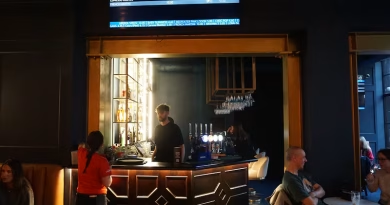
It was an educational city break that held honourable mentions in O’Reilly’s Irish bar, almost a given at this point to familiarity. Proof that no matter where you go in the world, there will be a seat in an Irish pub ready to pour a pint of Guinness. A boat trip through the UNESCO world heritage canals, and a visit to the infamous Anne Frank Huis, one thing stood clear. Tolerance is a key part of society in Amsterdam, facilitating both economic and cultural growth. Freedom exists within boundaries, and the city embraces tolerance. Tolerance to sex work, tolerance to cannabis and religious freedom. Tolerance of intolerance is intolerance, a strength that the city prides itself on, right at the heart of Europe.