
Bogside Bonfire Raises Burning Questions For Ulster
By James Tourish
Bonfires in this small part of the world, aren’t exactly a new phenomenon. On the night of the 15th of August, a bonfire in the Bogside area of Derry was lit, with at least hundreds in attendance. Described by journalists and politicians alike as ‘controversial’, the Bogside bonfire attracted an array of criticism from the onset, local Foyle MLAs, clergymen and even the First Minister, Michelle O’ Neill, voiced their displeasure at the event, with the Sinn Féin Vice President stating on social media, ‘There is no place for illegal bonfires unregulated bonfires or the burning of flags and emblems’ [1], referring to Derry, as well as to bonfires traditionally lit in July, in loyalist areas.
Bonfires in Republican areas are traditionally associated with the Catholic Feast of the Assumption, but in recent times the pyres are often more relevant to these communities commemorating the introduction of internment without trial, a policy that began in 1971, and predominantly affected those of a broadly Irish nationalist background. In recent years the bonfire in the Bogside has attracted controversy, with the names of murdered police officers, poppy wreaths and flags associated with Ulster Unionism, all being placed and burnt on the bonfires. The site of the bonfire, was also that of an area earmarked for development, and the construction of social housing, however the company in charge of this stated that they could not find a contractor willing to clear the area of the pallets and material.

This year, the self-styled ‘Bogside Bonfire Committee’, which organised the bonfire and the associated activities, aimed to make the event more community – orientated, with fireworks, a barbecue and even live music at the site of the bonfire, in Meenan Square. However, as the organising committee stated in a social media post, ‘the Bogside Bonfire is not a neutral festival, or a public relations exercise. It is an act of political expression, led by young people, rooted in a community that has lived through state violence, occupation, and decades of discrimination’ [2]. Although condemned by mainstream Republican and nationalist voices, like those of Sinn Féin and the SDLP, it was clear that the bonfire was an expression of a minority in these republican areas, that do not feel that the political positions at Stormont and Westminster represent them and their views. This is not to say they are diametrically opposed, but there is something missing.
It was an occasion, that seemed overall rather gleeful for those in attendance. People were drinking, chatting amongst each other and listening to the DJ, that was playing while the burning pyres fell over each other. Police kept a distant, but visible presence, using the city’s walls as a vantage point to oversee and record the event, opting not to take a more head on approach, one that has caused issues in the past while trying to remove material from the bonfire. There was some minor disorder, with masked youths throwing bottles at the PSNI on top of the walls, however certainly nothing the police haven’t seen before.
The Bogside bonfire was lit, shortly before 11, following a fireworks display, to a large roar from the crowd. ‘Their burning is an act of resistance, not hate’, wrote the Bogside Bonfire’s committee [2], referencing the different flags, symbols and materials being engulfed in flames. Whether justified and legitimate, or wrong and outdated, hundreds turned out for this bonfire, despite repeated calls of condemnation and criticism, it was clear that for many in attendance at the night’s activities, the bonfire represented for them, a political expression that they had felt, has been overlooked by those in mainstream Republicanism.
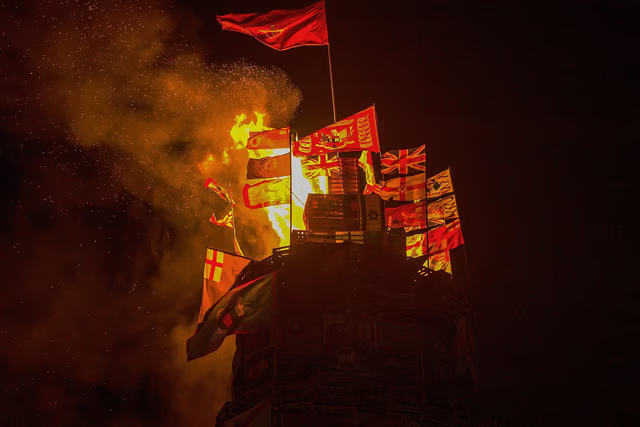
From this, there must be questions. Firstly, should politicians, journalists and society, overlook this event as a political stunt, that belongs in the past and is not representative of society, or should there be some level of engagement, with the expression of a largely working – class section of society deemed worth listening to, rather than blanket condemnation? Support may be minimal for bonfires in Republican areas, broadly speaking at least, – but did we really get to where we’re at in this small part of the world, with relative peace, and greater integration than before, without the policy of engagement and understanding? No one wants to see ugly scenes, or blatant sectarianism, that is clear and should be rightly condemned, but does the incendiary pallets and smoke represent a minority view that has been, with no pun, smothered and snuffed out? Others, will take a less so sympathetic approach, illegal bonfires, with no regulation and little support from the bulk of society, should not deserve any airtime, nor the views of those who organise them.
Bonfires are a contentious issue, and are likely to remain that way for many years to come, however we do indeed have some questions to answer, about their viability and what their purpose should be in coming years, and it is the youth, who should be putting their voices forward, as ultimately, it is our future that will either include these historic celebrations of culture, or ugly piles of burning pallets.
References
[1] Breen, S., (2025). “58% of people in NI would support creation of a commission to regulate bonfires and flags”. Belfast Telegraph, 17 Aug 2025. https://www.belfasttelegraph.co.uk/news/politics/58-of-people-in-ni-would-support-creation-of-a-commission-to-regulate-bonfires-and-flags/a622669591.html
[2] Bog Bonfire 2025, “Statement from the Bogside Bonfire Committee”. Facebook, 3 Aug 2025. https://www.facebook.com/bog.bonfire.2025/posts/pfbid0ZQ2v8vuEBedc4BLpfpmzY3pwfjdzy7HoXKWB73qhhgyGrmv7xjNHrPMVdGFhJW8gl
Image 2 credit: George Sweeney
